Billy wallson
Senior DirectorA close look at the slow, deliberate hunting techniques that make herons some of the most successful predators in the wetland.
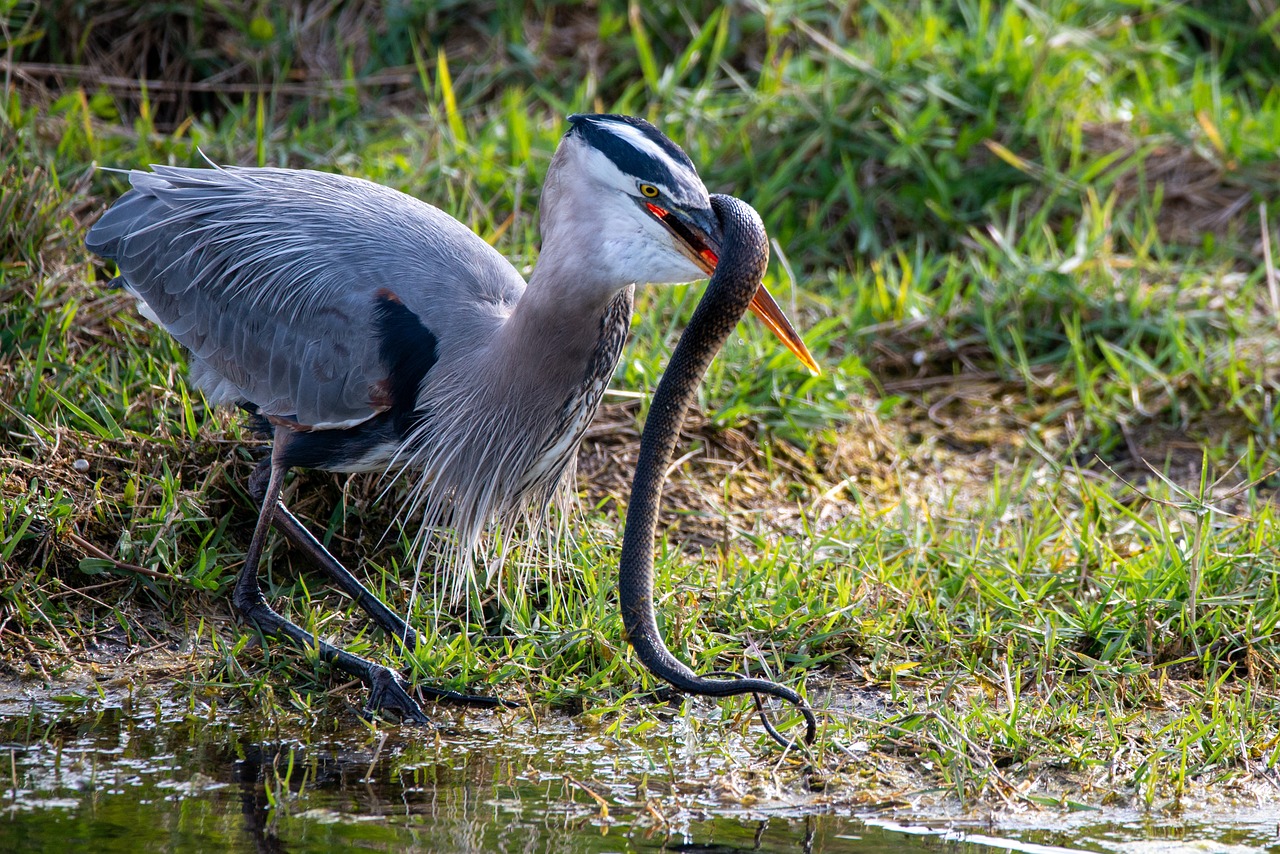
If you have ever looked at a big grey heron standing in the shallows and felt a flicker of doubt about which species you were seeing, you are in good company. Great blue herons and grey herons are close cousins with overlapping habits, similar proportions, and a shared talent for standing motionless in the exact spot where you are trying to identify them. The good news is that once you learn a handful of field marks, the confusion mostly disappears.
The first thing to sort out is where you are. In North America, a large grey-and-blue heron is almost certainly a great blue. In Europe, Asia, and parts of Africa, it is almost certainly a grey heron. Range does most of the work for you, and it is worth checking a range map before you start squinting at feather detail. But there are places and situations where the two can genuinely overlap in a birder's mind, especially for travelers, and that is where the field marks matter.
Start with the head. Adult great blue herons have a striking black plume that sweeps back from above the eye toward the nape, and the crown itself is white. Grey herons have a white head and neck with a dark streak running from the eye backward, but the overall impression is paler and less contrasty. The great blue's face often looks darker and more heavily marked, especially in breeding plumage when the lores take on a brighter tone.
Then look at the neck and body color. Great blues tend to read as slate blue-grey with warm rusty tones on the neck and shoulders, particularly on the sides of the neck where the feathers can look almost chestnut. Grey herons are more uniformly grey, with less of that warm wash, and their neck often appears paler and cleaner. In flight, great blues show dark flight feathers that contrast with paler coverts, and their overall size tends to be a touch larger and bulkier, though size alone is a poor field mark when a bird is standing alone.
Legs and bill can help too. Both species have yellow-ish bills in adults, but the great blue's bill often looks heavier and slightly longer relative to the head. The legs of a grey heron are typically a duller yellowish-grey, while great blues can show darker legs, especially on the upper portions. None of these is foolproof on its own, but stacked together they usually settle the question.
Behavior can nudge you toward an answer as well. Great blue herons are famous for their slow, deliberate hunting style and their willingness to hunt in a wide range of habitats, from salt marsh to farm pond to backyard koi pond. Grey herons are similarly adaptable and are a familiar sight in European parks and rivers, often standing on the bank or in very shallow water. Both fly with slow, heavy wingbeats and both tuck their necks into that characteristic S shape in flight, so flight style alone will not separate them.
The real takeaway is to lean on range first, then head pattern, then overall tone. If you are photographing a bird and you are not sure, take plenty of frames showing the head and neck clearly, and note the location and date. Those two pieces of information plus a good look at the face will almost always give you a confident identification, and that confidence is worth building before you start worrying about subspecies and regional variation.

When the light is against you, stop fighting it and start using it to create graphic, moody heron photographs.

When the light is against you, stop fighting it and start using it to create graphic, moody heron photographs.
A close look at the slow, deliberate hunting techniques that make herons some of the most successful predators in the wetland.

These two large herons look strikingly similar at a glance, but a few reliable field marks separate them quickly once you know what to look for.

A close look at the slow, deliberate hunting techniques that make herons some of the most successful predators in the wetland.

Flight shots of herons are within reach with a few practical adjustments to your settings, your position, and your expectations.

Copyright © 2026 Heron Hollow. All Rights Reserved.


Roseanne Williams
Sep 17, 2026 ReplyThese two large herons look strikingly similar at a glance, but a few reliable field marks separate them quickly once you know what to look for.